Author Archives: Dan

Evaluation of My Months of Intentional Order

This challenge has honestly been one of the most transformational of any that I have done, but not in the usual way. Normally when I think of transformation, I think of mental framing or empowering beliefs.

My current transformation has been almost entirely physical. I can actually enjoy just walking around my living space or classroom because I don’t see or imagine clutter everywhere. Here is what I learned from the challenge:

  • The Clutterbug podcast is awesome! – When I started this challenge, I subscribed to a few different podcasts I found by typing “order” in the search bar. One was about room design and architecture – not needed. One was 5-minute practical house ordering tips – not mindset-focused. Clutterbug was exactly the ticket: practical suggestions, mindset frames, tough love, and an engaging personality. I do know that the listener demographics are 99.9% female, but I’m happy to be one of the 5 males that listens and benefits.
    Clutterbug - Real-Life Hacks and Tips to Declutter, Organize and Clean your Home Fast - Podcast - Apple Podcasts
  • Very little effort now prevents massive stress later – The most salient feature of the challenge was the 2-minute rule: if a task takes less than 2 minutes, it MUST be done immediately. The extra 10-30 seconds it takes to put the keys into the drawer or hang the coat up or rinse out the Ziploc bags pays such huge dividends. No more rushing around the house wondering where my keys are or why my coat isn’t hung up or disgusted about a messy lunch box.
  • Do NOT wait to buy organizational products – Forcing myself to buy organizational aids was the biggest reason for my decluttering success. It is very easy (and even fun) to declutter and tidy an area when designating spots to put things is readily available. This is one category I will no longer allow myself to wait, research, and look for savings. My time and energy are getting sapped right now, and remedying that is worth more than avoiding potential regret or saving a few bucks.
  • Clean drawers provide a palpable sense of relaxation – After cleaning out and organizing my desk drawers both at home and my classroom, I noticed a meaningful reduction in my level of stress when doing work. I did not even know I was experiencing this sense of tension until it evaporated and I felt 2 pounds lighter and 10% more focused.
  • Shifting focus from an end result to a process is key – My previous default when attempting organization was something along the lines of “This room needs to look organized,” or “This shelf needs to be cleared out.” My goal was either too large or ill-defined, especially as someone that is not a natural declutterer. Smaller and more specific goals like “Put compartments in this drawer,” or “Spend 10 minutes on this shelving unit,” were effective because I could be proud of the effort even if the overall space still felt disorganized. This encouraged continued small effort which eventually produced the desired result.
  • When forced to stay organized, you naturally find or create systems that make it faster and easier – If I allow myself to only sometimes make the bed or only sometimes put up the laundry, then not only is my environment less tidy, but it takes me longer to do these tasks since there is no pressure to check them off. Requiring the bed to be made before I left my bedroom allowed me to stop trying to fix the top sheet and instead just drag it with the comforter and quickly fluff. Good enough! I finally stopped folding all of my underwear and workout shirts and instead got rid of some unused clothing and created a space where I could just throw them into the drawer. Good enough!
  • It all starts with the laundry and dishes – Initially I was uninterested in making these tasks central to the challenge. However, they do occupy the majority of my tidying time. Little things like less rinsing, more throwing things in the dishwasher, and using detergent sheets instead of powder for the laundry saves precious minutes – minutes that can then be used to tackle more serious clutter issues.

What I want to do going forward:

  • 5 minutes a day – This is what I want to commit each day to organization. Any time commitment is a sacrifice, since there are only 24 hours in each day. However, I have no doubts that this is worth the time, and a lot can be done in 5 minutes.
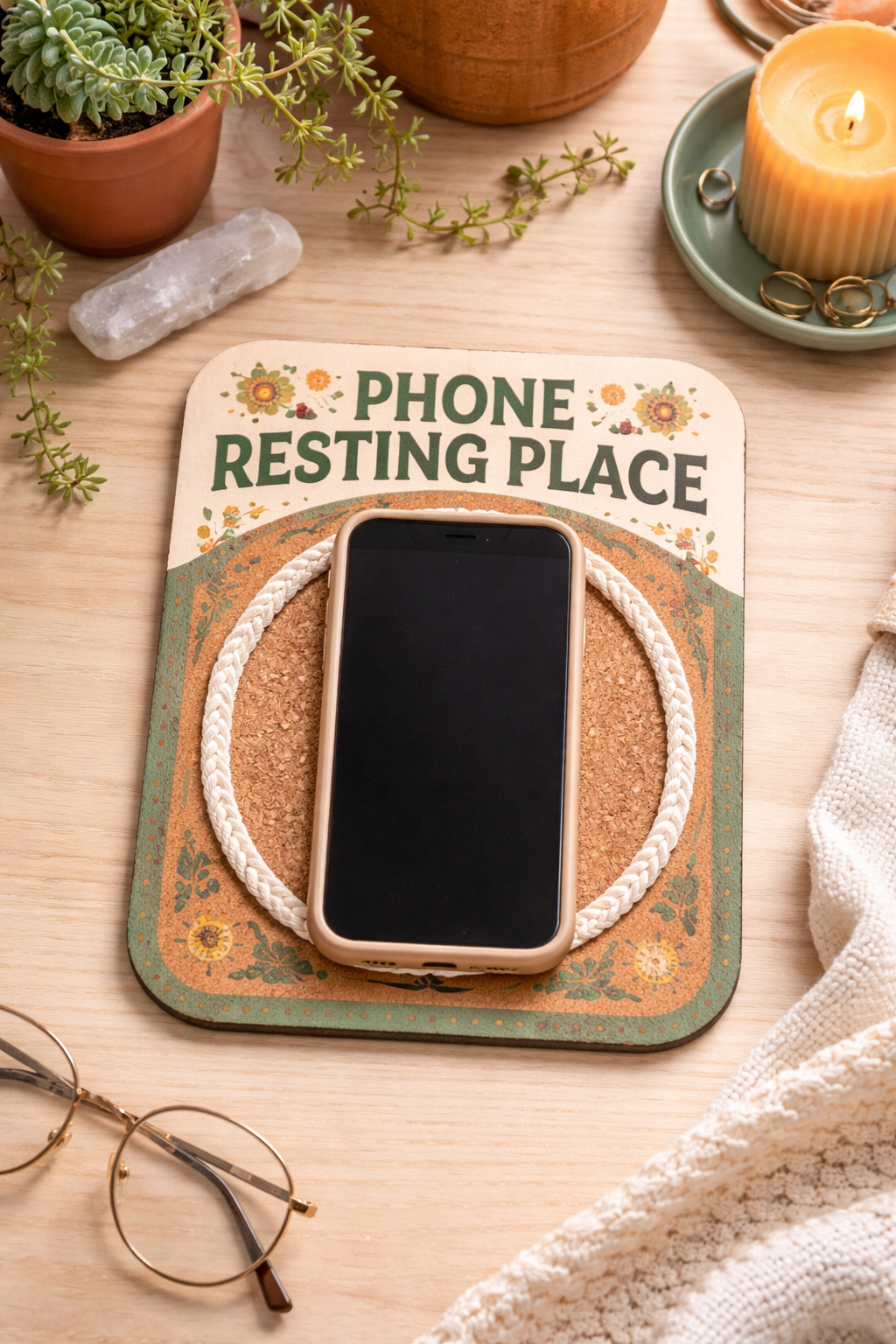
  • Visually designated phone areas – There are only 3 locations at my apartment and 2 locations in my classroom where I allow myself to drop my phone. However, I want to make this easier to abide by and also enjoyable by designing visual phone pit stops to reinforce this behavior.
  • 30-second rule – The 2-minute rule is great, but not always practicable. I don’t always have 2 minutes if in a rush to get out the door or deal with students. However, I can always make time for 30 seconds, especially if I put a little hustle into it.
  • Organization & Aesthetics minimum monthly budget – I have a very loose budget for my major expense categories. However, I have never had a line-item for organization (this was subsumed under household). I want this to change. Also, I want to establish a minimum amount I must spend or else donate to charity. I am not worried about over-spending, but I am worried about under-spending and this should help.
  • Purposely do one thing shitty each week – I often postpone organizational or cleaning projects because I don’t think I can complete them properly. But that is the problem – properly doesn’t matter! This sentiment is heavily influenced by Cas Aaresson. Doing something subpar is always better than not doing anything at all.

May your mind, body, and environment be free of clutter and open to experience. May you inhabit the joy of living in divine order.

Namaste.

A Month of Standing Meditation

The motivation for this month’s challenge is twofold. First, I would like to increase my level of physical comfort when standing. I have an array of shoes that attempt to minimize the back pain I have when standing. That being said, I still feel quite uncomfortable when simply standing still.

Second, I would like to cultivate a mindful way to pass the time when sitting and walking are not options and I don’t want to retreat to my mind castle. Most notably, this would include times at school where I have the duty to monitor students before school or during meals. In fact, this is regularly one of my most dreaded activities.

In settling on the particulars for this challenge, I researched a few questions:

  • Is there a recommended way of doing this physically? – A common misunderstanding of seated meditation is that palms should face upward. This is almost entirely performative since holding your arms in this position increases strain. With walking meditation, it is important to choose a straight length of even ground and walk back and forth – very different from walking a path through the woods.

    From what I could glean, these types of unskillful approaches are not really present with standing meditation. You can of course find any number of instructions, but nothing seems universal apart from the basics of good posture. One common variation is to adopt a tree-hugging pose (as shown here), but I will not be applying this due to back strain.
  • Are there any additional benefits of standing meditation? – I like to know about scientific benefits to spiritual practices principally because it allows for interest to be developed in people that would otherwise reject or ignore them. According to eomega.org, no scientific studies have been done specifically on standing meditation. However, planetmeditate.com lists several purported benefits, including improved posture, balance, and muscle tone.
  • What forms of martial arts utilize this? – Two schools that use this as a core component of practice are Tai Chi and Qi Gong. There are others as well, but I didn’t recognize any of them. There is also a term for this pose, Zhan Zhuang (pronounced Djon Djwong), which carries a Daoist context from the Wudang Mountains.

Without further ado, here are the specifics for my challenge:

  • Work up to 10 minutes daily – I will start with 4 minutes and increase by 2 minutes each week. A good time to practice might be before showering in the morning.
  • Add this to my existing routine – I picked up the intention after reading Why Buddhism Is True this past month to increase my daily meditation practice from 10 minutes to 20 minutes. This month will be facilitating that intention.
  • Utilize guided meditation – I don’t generally used guided meditations. However, I think they can be extremely helpful when adopting a new technique. Here is a 10-minute guided practice, specifically related to standing meditation.
  • Focus on 3 core hand positions – As mentioned above, I will forego tree-hugging pose. My 3 positions will include hands-at-sides, prayer pose, and Dantian position, though I will do the latter at the navel instead of below.
  • Twice a week, engage in mini-sessions – I want these to be between 30 and 60 seconds. The point is to practice bringing what I learn from formal practice into everyday experience.

I am very excited about this challenge, as I believe this form of meditation is applicable in a lot of situations where traditional seated or walking meditation would not be.

Namaste.

A Month of Intentional Order

It has been a minute since I last posted. I started a challenge last month which I renewed for a second month because it is something I desperately need: intentional order.

Recently, I have started to explore the shadow parts of my personality. In Jungian psychology, these are the 4 cognitive functions that are relatively unconscious to us and considered ego-dystonic, meaning we struggle to identify with them either positively or negatively.

The last function in my shadow is introverted sensing, which is occupied with organizing our environment, information, and experiences. I’ve always viewed this function as something that I was at least mildly competent in utilizing – definitely not as a repressed or unconscious part of myself. I think this stemmed from the fact that most of my immediate family has this as one of their dominant functions.

If you asked me a year ago, 5 years ago, or 10 years ago, if I was an orderly person, I would have said yes. However, I think I was confusing an ordered internal environment with an ordered external environment. Recently, I have become more aware that all of my everyday spaces feel cluttered, even when I don’t have that much stuff in them. Also, I lose and misplace things all the time, sometimes having to look for the same item multiple times a day.

A deeper concern, however, was that I felt completely lost when thinking about fixing some of these issues. This was the impetus for my current challenge. Here are the specifics:

  • Find and listen to a podcast – I need external motivation, encouragement, and ideas with regards to organizing my environment. More so than any other area, I easily feel lost. The challenge: 15 minutes a day of some type of organization podcast. Experiment to find one that I enjoy and is effective for me.
  • Immediately put away used items – I like the rule I heard recently that if it takes less than 2 minutes to clean up something or put it away, always do it immediately. This also means only having certain locations where you allow yourself to drop things (phone being the prime example).
  • Purchase organizational products – Another difficulty I have noticed when I do try to be more tidy, is that sometimes it is impossible to do so because I don’t have enough places to put things. This is not because of too little space, but because of not enough structured compartments within that space. I want to purchase at least 1 organization aid each week.
  • Dedicate time each day for organization – A tidy space is not going to happen on its own. However, it also doesn’t have to take enormous swaths of time. I am committing to 10-15 minutes each day; initiating this right after meditation would be a plus.
  • Exclude laundry and dishes from dedicated organization time – I want to break new ground, so to speak, with my organizational habits, not just get the laundry or dishes done sooner. If I am trying out a new way of doing a daily task, that can be fine; otherwise, I want to tackle new areas.

The biggest lesson I have been learning in this arena in particular (but really in all of life) is to simply do things a little better or get things a little cleaner. Also, sometimes doing a task wrong is a good thing if it simplifies a routine and eliminates visible clutter more quickly.

Namaste.

Evaluation of My Month of Slowing Down

I am very glad I started this challenge. I believe it imparted a greater sense of general equanimity in my life. Here are some specific insights:

  • Walking meditation is heavenly – Prior to this month, I’ve only seriously done walking meditation in the context of a retreat. Like many good things, it is an acquired skill. Walking very slowly can make you feel unbalanced and incredibly self-conscious. However, as you start to accept those feelings and work with them instead of fight them, a transformation occurs. I feel it is also easier to bring this energy into regular life than with seated meditation.
  • Deep breathing is a terrific default – Of course, I knew this implicitly, but having it as part of the challenge made it feel more significant and grounded. I truly am amazed at how many unskillful emotions and urges are eliminated or seriously abated by simply taking 3 super long breaths. I think 10-count breaths feel about the perfect length for this.
  • Targeted, deliberate mindfulness is necessary to set a general tone – Meditating and adopting Buddhist-flavored beliefs is a great start to mindful living, but it will only take you so far. For the mindfulness to percolate throughout your routines requires deliberate focus. In short, mindfulness requires SLOWING DOWN, at least initially. For those used to a default speed of high, this will feel forced and awkward. Let it. Believe in the practice and the results will come in their own time.
  • Listening without responding is hard – Maybe it is because as a teenager, I was incredibly socially awkward and fearful, I still associate being able to speak confidently as a skill, while being able to listening empathetically as a choice. However, at this point, the opposite is true. Speaking confidently I can fairly easily turn on and off at will. To really listen, however, not as a launchpad for responding, but simply to understand and validate, is difficult.

I have a feeling I will conduct modified versions of this challenge in the future, perhaps focusing on slowing down and bringing mindfulness to specific areas of life. For now, I am content to just breathe in, breathe out, and release life to unfold in its own messy and perfect way.

Namaste.

A Month of Daily Reading

One of the philosophy zoom meetings I attend is the Denver Philosophy Group on meetup. After each monthly meeting, the host gives an opportunity for each participant to share what they have been reading or thinking about. Many times, the only authentic share I have is from podcasts and I wish I had an actual book to talk about.

This month’s challenge is fairly simple: I want to physically read and listen to audiobooks every day. The specifics:

  • Read a physical book for at least 15 minutes each day – I am going to start the first week by continuing to read 2 books that have been on my shelf for a while: Cringeworthy by Melissa Dahl, and How We Live Is How We Die by Pema Chodron.

How to Read a Book Inspectionally | Adam Smith Works

  • Listen to an audiobook for at least 15 minutes each day – I just signed up for a free month-long trial of Audible and used 1 credit to download Mel Robbins’ book: The Let Them Theory. I will start this week with that.
  • Every Sunday, start a new book and audiobook – Whether I am finished or not, I want to keep moving on; if the book was really engrossing, I am sure I will want to finish it on my own time; if not, maybe just skimming the rest is best.

I recently signed up for a HOTWORX fitness studio membership which is a 10-minute drive from where I live, so I should have plenty of opportunities to fit in the audiobook time. As for the hands-on part of the challenge, reading in bed for 10-15 minutes is a great last-resort option and also tends to help me mentally unwind, provided the book isn’t a fiction thriller.

I live very close to the Longview Public Library, so acquiring physical books should not be a problem. I went yesterday prepared to buy a new library card (I couldn’t locate mine) and someone had serendipitously found it on the sidewalk and returned it!

Namaste.

A Month of Slowing Down

I could have titled this ‘a month of increased mindfulness.’ However, I really want to capture the intention of just taking things more slowly.

Here are the specifics:

  • Only listen to audio at a regular speed – I frequently listen to podcasts or other media at 1.5x speed or faster. I find it more engaging plus I can then get through more podcast episodes. In the interest of embracing the moment, I will suspend this tendency.
  • Practice daily walking meditation – Probably the most visceral way of slowing down is by purposefully walking slow. Outside of meditation retreats, I rarely practice walking meditation. This can be in lieu of my seated practice so it doesn’t have to be an extra item on my schedule.
  • At specific times, intentionally take 3 super long breaths – I have started prescribing 30 seconds of meditation at key transition moments throughout the day that have been instrumental in regulating my emotions. I want to do the same thing but with deep intentional breaths. Also, breathing can be utilized even when meditation could not.
  • Speak slower or not at all – I want to speak less and be okay with it. Take time to consider the five considerations for Buddhist speech: Is what I am saying true? Kind? Helpful? Timely? Gentle? If not, simply refrain.
  • Choose one activity each day to move slowly through – This could be the same thing every day or different things on different days. Treat each action as though it is part of a solemn ceremony. No motion is rushed or thought of as insignificant. What this means practically is that I need to budget at least twice as much time as I normally would.

I have no problem at all with being a person that likes to move quickly. However, I equally value being able to thrive in stillness. My meditation practice alone is not enough to counteract my natural nervous energy and fidgety body. Hopefully this month’s challenge will.

Namaste.

Left vs Right

One of my favorite listening pastimes while biking is Chris Williamson’s Modern Wisdom podcast. His interests of evolutionary psychology, fitness, dating, communication, and mental health are closely aligned with mine. However, 5-10 percent of the time, he brings on a guest to discuss political ideas and this is where I would start pulling my hair out if I had any left.

This visceral reaction on my part raises some questions. Why do I react like this? Is it simply because most of the political guests are more right-wing than I am? What does this even mean? Should I just not listen to these podcast episodes when they pop up in my feed? Would this refusal be admitting defeat: that I cannot even tolerate listening to a different perspective?

All of these questions are interesting and worth exploring. However, I think the biggest problem is a linguistic one. Specifically, I am referring to the use of words like left, right, liberal, and conservative as useful categorizations in a broad sense. What does it mean to be ‘on the right’ or ‘on the left’? Is there some magical line that distinguishes between the two? Making a ‘center’ option just compounds the problem, because now I have to draw two lines instead of just one.

Also, the idea that one word could even approximately capture an individual’s ideas on foreign policy, healthcare, fiscal policy, and social policy, just seems absurd. Even if it could for a particular person, it would not generalize to a large group of people in any useful way.

Is the solution to just excise words like left, right, liberal, and conservative from our vocabulary? That is one option, but I believe there is a less radical approach that can avoid a lot of the hasty generalization inherent in the usage of these words. Here are a few simple rules that will help:

  1. Use these words sparingly – When possible, just talk about specific issues and circumvent these broad categorization words entirely. Instead of saying, “The left’s view on healthcare is crazy,” say “I think there are major problems with a universal healthcare system.” Instead of saying, “The right’s immigration policy is barbaric,” say “I believe deporting long-standing residents with no criminal record is wrong.”
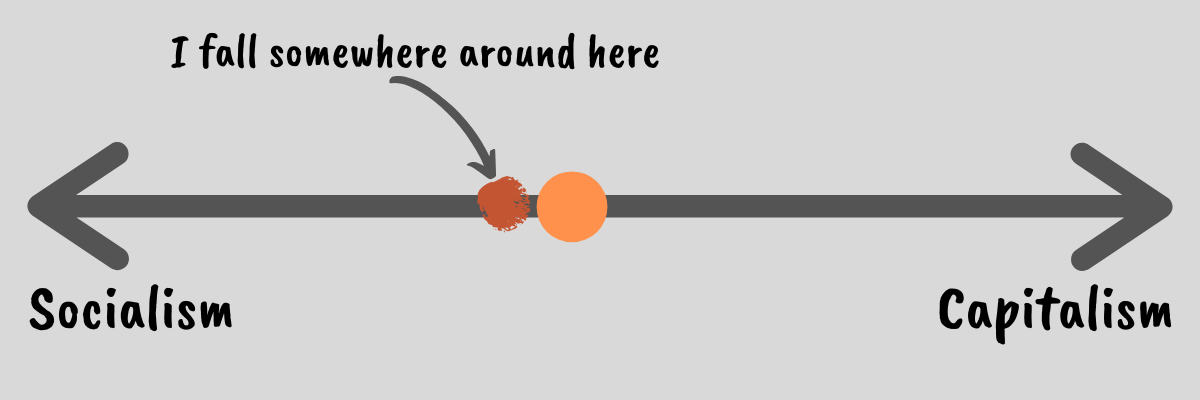
  2. Only use general words to refer to one specific spectrum or concept – For example, when using the words “left” and “right,” I am only referring to the socialist-capitalist spectrum and nothing else. If this is unclear, I will modify it to economically left and economically right.

    How Socialism Turns into Capitalist | Curated Newsletters

    If using the the terms “liberal” and “conservative,” I will always define in as simple terms as possible what I mean before using them. I’m also happy to completely discard these labels if I feel there is any tension with them in a particular context.
  3. Generally refrain from using these words in an objective sense – Instead, use them relatively. For example, “Bernie Sanders is further left than Chuck Schumer.” This avoids the problem of whether Sanders or Schumer are truly ‘on the left.’ I think we can objectively say that Sanders is to the left of Schumer. Alternatively, we could say that Schumer is to the right of Sanders. Both of these communicate the same relative truth.
  4. Only apply labels to people that they apply to themselves – A lot of people will initially balk at this rule. “I can’t call him a “fill-in-the-blank” when he clearly is one?” I would say no. What you can do is quote specific things the person supports and let the listener make up their own minds on “what they are.”

    As someone that rarely fits neatly into labels, there definitely is a personal element to this rule. I can experience intense frustration when someone uses a word to describe me that I would not use. Therefore, I am happy to give everyone the same courtesy I would ask for myself.
  5. Don’t use the phrase ‘self-described’ – Even with the best of intentions, this easily comes across as patronizing or dismissive. A better alternative is simply “identifies as,” if you don’t feel like using the label a person calls themselves without a qualifier.

Bringing this back to my podcast dilemma, I believe starting those podcasts is a good idea (don’t dismiss them out of hand). If it becomes clear early on that the focus will be on left vs right generalizations, then skip it. On the other hand, if it delves into discussing the pros and cons of specific policies, regardless of whether you see things differently, give it a curious listen.

Walking the line between being selective about what you listen to, while also making sure you are hearing opinions and perspectives radically different from your own, is a tough act. The above are my initial thoughts on navigating these treacherous waters.

Namaste.

Labels are Messy, but I think I’m Pan-Spiritual

I am incredibly reluctant to discuss my thoughts and beliefs relating to metaphysics, specifically the nature of the divine, consciousness, and the sense of meaning and purpose one might derive from their understanding and experience of these perspectives. I think my biggest hang-up is the seeming inability to communicate coherently on these topics.

I unreservedly will call myself a mystic, because the essence of mysticism is simply the experience of the divine, without borders. There is no necessity in mysticism to explain anything, simply to promote divine experiences, however you want to define them. I believe most people would benefit greatly from pursuing mystical experiences in their lives.

However, while I don’t claim any hard and fast beliefs about the nature of the divine, I do enjoy playing with and trying on ideas. My grounding in these mental pursuits is always direct experience. Sometimes the beliefs themselves, while not essential, are a helpful on-ramp to the experience.

With all that in mind, I want to develop the confidence to speak on this topic (my tentative beliefs about the divine, not just my experience) without feeling inadequate or defensive or invoking these reactions in others. I think the first step in this endeavor is finding a broad label that encompasses most of the belief systems in this arena, and using that as a launching pad to dip into more specific ideologies.

In my research, I couldn’t find any formal label that fits the bill. They either were too specific (e.g. panpsychism, pandeism), or used unknown or uncommon terms (e.g. immanentism). So, I’m settling on pan-spiritual. Spirituality is the process of seeking and finding meaning, purpose, and a connection to something larger than oneself. As a Greek prefix, pan means “all,” “every,” or “entire.”

Spliced together, pan-spiritual means something along the lines of, “the process of seeking and finding a universal sense of meaning and purpose that is larger than ourselves while at the same time intricately connected to our inner being.” I would also nest pan-spirituality under the topic of mysticism. You can be a mystic without being pan-spiritual, but not vice-versa.

With that extended preface out of the way, what specific form of pan-spirituality do I find compelling at this time? That would be transpersonal panendeism. I will save a full exposition of this for a later post, but here is a brief overview:

  • Trans = beyond
  • Personal person/self
  • Pan = all
  • En = in
  • Deism = the Divine (non-interventionist)

Put together, this is a belief that the Divine both permeates the universe while also transcending it, and has attributes that go beyond the boundaries of a unified person. In other words, there are at least 2 main conceptions of God that are both true: a universal substance (maybe consciousness, but not necessarily), and an intelligent presence (maybe with the omni attributes, but not necessarily).

What this means practically for me is a few things:

  • The ways to conceptualize the divine are infinite – Since God is transpersonal, the divine can be approached as a he, she, or an it; as a guru, friend, or lover; as a still small voice or the majesty of nature. We are in God and God is in us.
  • The experience of the divine is possible in every moment – Everyone and everything is part of the divine fabric. Therefore, experiencing the divine simply involves waking up to this perspective. It can be as fundamental as purposeful breathing or as exotic as an out-of-body experience.
  • These experiences ground meaning and purpose – What are some things that the omni-version of God cannot experience? If you are all-powerful, you cannot experience the satisfaction of building skill. If you are all-knowing, you cannot experience the thrill of discovery. If you are all-present, you cannot experience the gift of awakening. By having these experiences, we add to the God-concept.
  • There is no need to fear chaos and destruction – It is not on me or even on humanity to save the world or end pain or fill-in-the-blank. I can trust in the structure of the divine tapestry and simply act with presence. I can have confidence that striving for these or other goals is its own reward even if I don’t see objective outcomes.

I will leave you with the first line from the Tao Te Ching:

“The Tao that can be named is not Tao.”

I find this excerpt both beautiful and humbling. It reminds me to always evolve in my understanding of the divine, to learn from the perspectives of others, and to ground all of my spiritual beliefs in personal experience.

Namaste.

Evaluation of My Month of Intentional Daily Thoughts

Last month, I completed a challenge that I didn’t blog about. I started the challenge a couple of days into the month and made up for the days missed. The essence of the challenge was incredibly simple: each day, have a structured topic that I think about anytime I have downtime. The biggest source of this downtime was driving, but other opportunities included grocery shopping and laundry.

The topics repeated each week, with each day devoted to a particular area. There are 4 biological macromolecules that I remember and teach to my students using the acronym ‘PLNC’ for proteins, lipids, nucleic acids, and carbohydrates. Each of these occupied one day. Here is a list of all the topics, In order from Sunday to Saturday:

  1. Core values and Opposite-to-Emotion action steps – I have identified 24 core values that I hold, a sampling of which includes purposeful passion, thorough expression, and functional health. Opposite-to-emotion action is a DBT skill useful for managing uncomfortable emotions that I have found incredibly effective.
  2. Buddhism Basics – This includes the four noble truths and the eightfold path. I have a simple mnemonic that I use to remember and talk about the eightfold path: ‘Understand This: Speaking And Listening Effectively Mandates Concentration.’ This stands for Understanding, Thought, Speech, Action, Livelihood, Effort, Mindfulness, and Concentration.
  3. Proteins – For each of the biological macromolecules, I used the acronym: SPA DAME MP3. This stands for Structure, Production, Acquisition, Digestion, Absorption, Metabolism, Energy Utilization, Major Functions, and 3 types of Pathology – deficiency, toxicity, and dysfunction.
  4. Lipids – Ditto above.
  5. Nucleic Acids – Ditto above.
  6. Carbohydrates – Ditto above.
  7. Top-to-Bottom Human Systems – These include the 8 overarching organ systems, 4 tissue types, 6 stem cell types, and 5 non-stem cell types. I call it top-to-bottom because I arranged the systems in the order they would appear if traveling from the top of the head downward.

Most of these areas I knew extremely well and it was just a matter of choosing to focus on them during downtime instead of my semi-regular toxic rumination. For the macromolecules, I did spend some time the first week of the challenge fleshing out a few details which I used the subsequent weeks to occupy my mind.

I smashed the challenge and mostly loved the process. The technique of just switching to pre-planned thoughts to occupy the mind I found to be incredibly effective, especially when I am tempted to ruminate unproductively about some recent event. Since the challenge has ended, I do enjoy not feeling the need to think, but if I’m not careful I can easily default to unskillful mental churning.

Going forward, I think what would constitute Middle Way in this area is to have something I plan on thinking through completely, but is simple enough that I could easily do it in a few minutes. Once I got into the process, I could expound and explore it further if I so desired.

I would love to just totally be with whatever activity I am involved with. To be fair, I feel like I am much more present now than I have been in a long time. However, in most situations, there is a steady hum of reaction, analysis, and judgment that exists in the back of my mind.

I choose to accept the hum, show myself compassion, and find skillful ways of managing it when it grows too loud.

May your thoughts be peaceful and may you be at peace with your thoughts.

Namaste.

A Month of Playing with Vegetarianism

For ethical reasons, I would like to become fully vegan, both in diet and lifestyle. Currently, I am 80% pescetarian and have been for several years. Without getting overly analytical, I don’t view the avoidance of causing indirect harm to vertebrates as a moral imperative, though I do view it as a very important moral good.

Hunting and killing vertebrates, even if done solely for food purposes (and not just sport) is causing direct harm and something I wouldn’t do. However, buying and eating meat products is not directly harming anything. In fact, I would wager that if I entirely stopped buying and eating meat products today, the direct amount of harm caused to animals wouldn’t change at all.

For both of these reasons, I don’t feel a moral necessity to not eat meat, though I would like to start moving more in that direction. To that end, this month’s challenge will be focused on exploring vegetarian meals, snacks, and supplements that provide all of the nutrition I want while also rivaling the taste of fish (if that is possible).

Here are the specifics:

  • Buy or acquire a vegetarian cookbook – At this point, I am focused on ovo-lacto vegetarianism, meaning I’m not worrying about my egg and yogurt consumption. Therefore, any type of vegetarian cookbook will be fine.
  • Spend 15 minutes each day researching – I am specifically trying to maximize my protein and omega-3 fatty acid intake. Also, I really enjoy the taste of fish, and want to look for vegetarian alternatives that are as satisfying as a filet.
  • Have 2 fully vegetarian days each week – Primarily, this would involve packing a different lunch option (maybe a salad), and trying out a vegetarian recipe for dinner or eating out and buying vegetarian.
  • Be fully pescetarian by the end of the month – This is a highly attainable goal. The only major shifts it would require is substituting lunchmeat for something else, and communicating to family and friends that I am officially pescetarian. This may require extra planning when visiting others to ensure I have adequate dining options.

I feel like this type of challenge is long overdue, and I expect several more related challenges within the next couple of years. One of the most basic moral principles in Buddhism is “Don’t cause pain.” I expect this to be a successful first step in fully actualizing that foundational principle in my consumptive habits.

Namaste.