The motivation for this month’s challenge is twofold. First, I would like to increase my level of physical comfort when standing. I have an array of shoes that attempt to minimize the back pain I have when standing. That being said, I still feel quite uncomfortable when simply standing still.
Second, I would like to cultivate a mindful way to pass the time when sitting and walking are not options and I don’t want to retreat to my mind castle. Most notably, this would include times at school where I have the duty to monitor students before school or during meals. In fact, this is regularly one of my most dreaded activities.
In settling on the particulars for this challenge, I researched a few questions:
- Is there a recommended way of doing this physically? – A common misunderstanding of seated meditation is that palms should face upward. This is almost entirely performative since holding your arms in this position increases strain. With walking meditation, it is important to choose a straight length of even ground and walk back and forth – very different from walking a path through the woods.
⠀
From what I could glean, these types of unskillful approaches are not really present with standing meditation. You can of course find any number of instructions, but nothing seems universal apart from the basics of good posture. One common variation is to adopt a tree-hugging pose (as shown here), but I will not be applying this due to back strain.
⠀ - Are there any additional benefits of standing meditation? – I like to know about scientific benefits to spiritual practices principally because it allows for interest to be developed in people that would otherwise reject or ignore them. According to eomega.org, no scientific studies have been done specifically on standing meditation. However, planetmeditate.com lists several purported benefits, including improved posture, balance, and muscle tone.
⠀ - What forms of martial arts utilize this? – Two schools that use this as a core component of practice are Tai Chi and Qi Gong. There are others as well, but I didn’t recognize any of them. There is also a term for this pose, Zhan Zhuang (pronounced Djon Djwong), which carries a Daoist context from the Wudang Mountains.
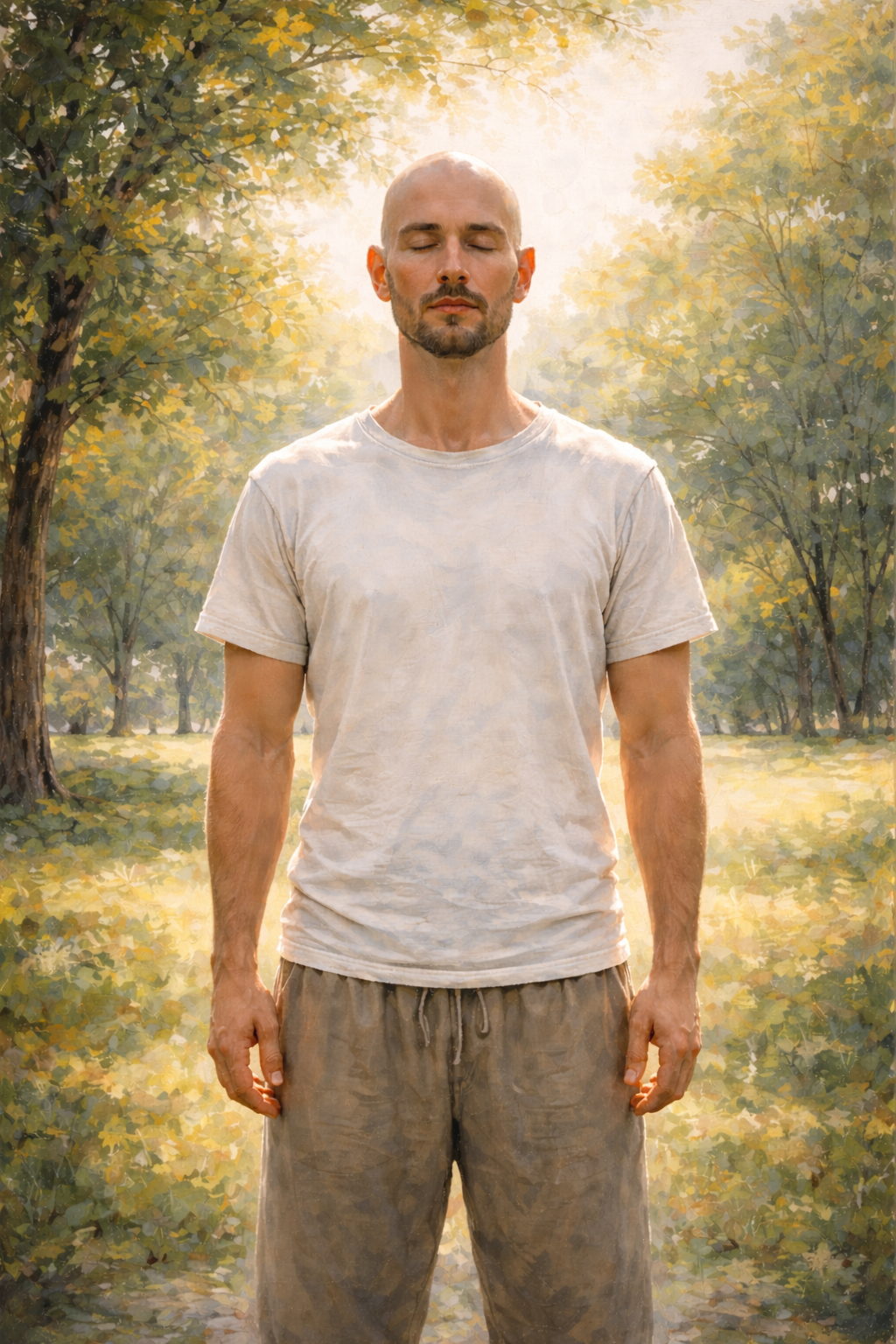
Without further ado, here are the specifics for my challenge:
- Work up to 10 minutes daily – I will start with 4 minutes and increase by 2 minutes each week. A good time to practice might be before showering in the morning.
- Add this to my existing routine – I picked up the intention after reading Why Buddhism Is True this past month to increase my daily meditation practice from 10 minutes to 20 minutes. This month will be facilitating that intention.
- Utilize guided meditation – I don’t generally used guided meditations. However, I think they can be extremely helpful when adopting a new technique. Here is a 10-minute guided practice, specifically related to standing meditation.
- Focus on 3 core hand positions – As mentioned above, I will forego tree-hugging pose. My 3 positions will include hands-at-sides, prayer pose, and Dantian position, though I will do the latter at the navel instead of below.
- Twice a week, engage in mini-sessions – I want these to be between 30 and 60 seconds. The point is to practice bringing what I learn from formal practice into everyday experience.
I am very excited about this challenge, as I believe this form of meditation is applicable in a lot of situations where traditional seated or walking meditation would not be.
Namaste.